

Liner Notes · The Album · 2026
I've been writing songs for over fifty years. For most of those fifty years, the songs lived in my head and in notebooks, and that was mostly where they stayed. Making a proper recording — a real one, with arrangements and production and something that sounded like an actual record — meant booking studio time, hiring musicians, and spending money I didn't have. I played live, solo acoustic, guitar and voice. The performances existed. The recordings mostly didn't.
I'd tried before
I want to be clear that this wasn't fifty years of wishing. I tried. There are albums behind me and a pile of recordings, some of them done in real studios. Around 2005 I put together a collection I called The Best So Far — a title borrowed in spirit from the Eagles' greatest-hits record, since none of mine had actually been hits either. Tomas Roller did the backing tracks for most of it. I tried recording myself. I tried the tools that generate backing tracks for you. None of it ever came back sounding like what I was hearing in my head.
It wasn't that the songs were the problem, and I had outside evidence of that. Some of those tracks went up on GarageBand.com — not Apple's app, the old indie site where other musicians rated your songs blind, without knowing whose they were. In early 2006 "I've Got To Find Out For Myself" took Best Melody, Best Drums, and Feel Good Track in folk rock over there, and that May it landed at number twenty-two on the American Idol Underground folk chart. Strangers who played for a living listened to that song and voted for it. The writing was holding up. The records weren't.
Then in 2013 I did something I'd forgotten about until recently. I picked my five best songs, put them on a CD, and typed the lyrics and chords into a little book: "I've Got to Find Out For Myself," "Wood on the Fire," "Light It Up in the Bedroom," "It Feels Like a Lullaby," and "Route #6." Five songs, chosen as the ones worth saving. Every one of them is a finished recording on Milestones now, thirteen years later.
And here's the thing nobody tells you about studio time: you think booking it buys you control. It doesn't. Once you're far enough in, you can't say let's scrap all of this and start over — it's simply too expensive. So you iterate instead, little parts at a time, fixing this, patching that, feeling like you're getting closer and closer. And at the end you have the finished thing, and maybe it isn't as good as you'd hoped, but it's good enough. I've had that experience. I pretty much gave up on it. I never expected to make money from a record — I'd watched friends do the whole indie math, spend to record, print enough CDs to break even, sell almost none, sit with a closet full — and I wasn't going to burn a big studio budget chasing that.
Then AI changed the math. Not incrementally. Completely. For the first time, scrapping everything and starting over costs nothing but available time — a good slug of hours that can stretch across several days, with no pressure. Even if a song takes a week, that's okay. And that, more than any other thing, is the game changer.
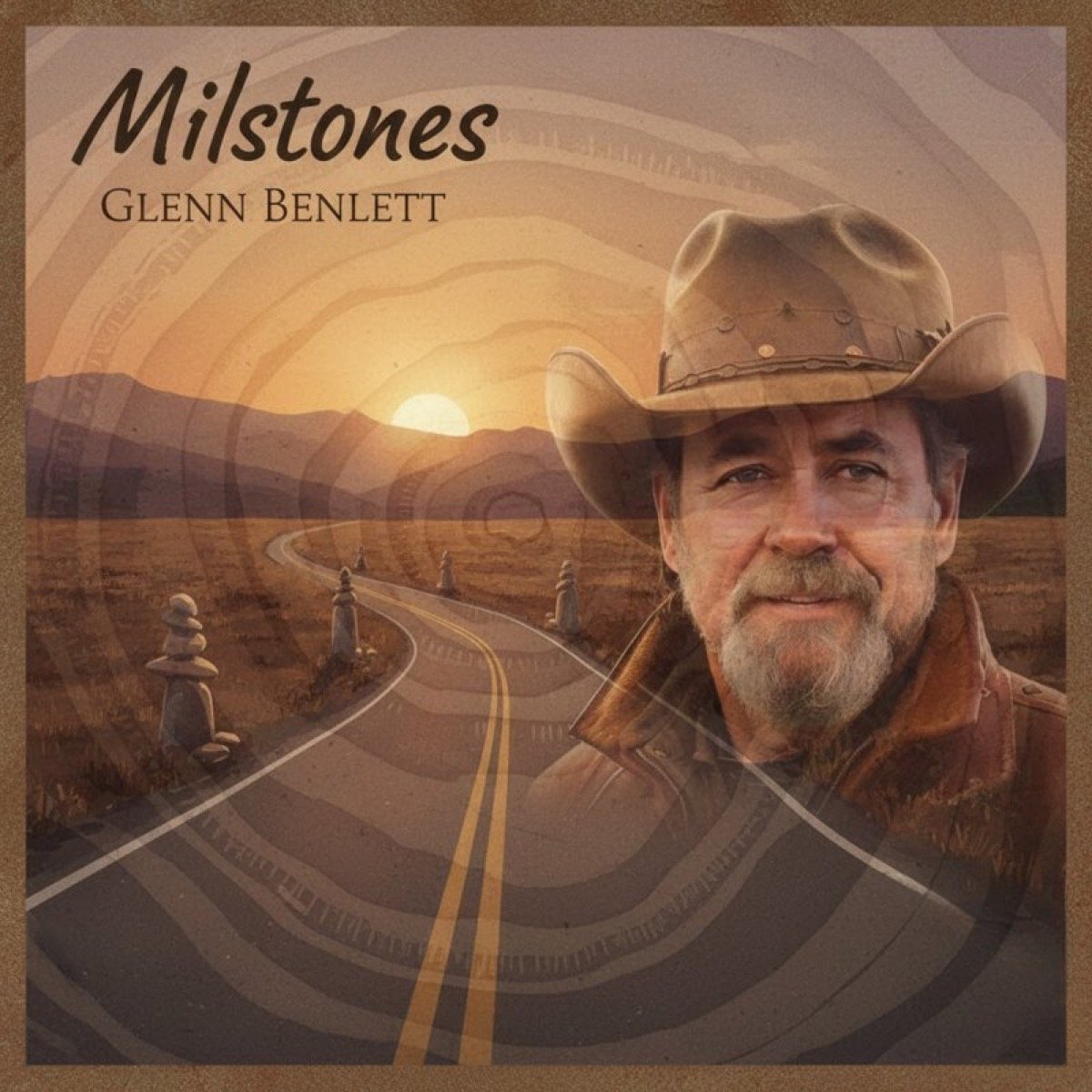
In 2026 I finished an album called Milestones — eleven songs, fully produced, in the California singer-songwriter tradition I've been working in my whole career. I made it in my home office in Moorpark, California, without a studio, without session musicians, without a label, and without any of the gatekeeping that had stood between me and a finished record for five decades. The genre listed on it is "Horse Whispering Music," which tells you something about the tone.
The tool I built to make it is called encore. It's a web application I wrote myself, running on top of a music model, that lets me turn song ideas into finished recordings using a trained model of my own voice. Not someone else's voice. Not a celebrity impression. Mine — the actual voice I've been performing with for more than fifty years, trained on recordings of me singing, now able to sing any song I write in any arrangement I can describe.
This is the story of how it works, why it carries the names it does, and what it actually felt like to make that album.
The naming problem
When I sat down to design encore, I needed a vocabulary. Every stage in the process needed a name — the cheap early iterations, the voice-on passes, the keeper take, the work-in-progress container, the head-to-head judging bracket. I could have called them Step 1, Step 2, Step 3. Input, Process, Output. I didn't.
Instead, I borrowed from the mid-twentieth-century American record business — the labels, the studios, the session players, the plain vocabulary of a tracking room. Almost every stage and object in encore carries a name from that world. The full tour of those names — including the two rooms I ended up tearing down — is its own liner note.
I wanted the app to feel like a studio. I wanted the terminology to carry weight — to remind me, every time I used it, that I was engaged in something with a tradition behind it. AI music is new. The human impulse to capture a performance, to get a sound on tape, to find the keeper take — that's as old as the recording industry itself. The names are a way of honoring that.
The Wrecking Crew
The first stage is called the Wrecking Crew, after the anonymous collective of elite Los Angeles session musicians who played on an almost incomprehensible number of hit records from the late fifties through the early seventies — Phil Spector's Wall of Sound, Brian Wilson's Pet Sounds, forty U.S. number ones with Hal Blaine on the drum stool alone. They were the invisible engine of American pop, and what they built, night after night, was the bed: the foundational backing track cut before any of the star's contribution went down. Their full story — and the documentary about them — gets its own liner note.
In encore, the Wrecking Crew stage is the first pass at any song. It starts with three things: a demo — me playing the song, guitar and voice, the way I'd play it at a gig, and the most important of the three — a song sheet with the lyrics and section-by-section instructions, and overall style information for the track. The model works from all three, weighted more toward the demo, so what comes back follows my actual performance instead of a generic idea of the song. No lead vocal on it yet. Just the track. And then I iterate, hard. Twenty to forty takes is typical for one song, sometimes more, before the backing is right. The one I choose to build on is called the Bed.
The song sheet and the style notes are me writing instructions for the session. The AI is the session player: it listens to my demo, reads the sheet, takes in the style, and lays down the track. And the producer I think about most while doing it is Brian Wilson — he arrived at the studio knowing exactly what he wanted, wrote it out as completely as he could, and waited to hear what came back.
And that's where the real work is. The challenge isn't getting a machine to make music — it's getting it to come straight up from the demo and stay there, to hand me back my song arranged instead of wandering off into something else entirely. Give it too much room and a quiet acoustic tune comes back as cowboy hip hop. So the demo carries the weight, the song sheet and style keep it honest, and I keep running takes until what returns is the song I actually played. It's the same idea as the genre name, pointed at a machine: not brute force, understanding.
Capitol — the voice goes on
The second stage is Capitol, after the tower at Hollywood and Vine built to look like a stack of records, with Les Paul's echo chambers buried thirty feet under the parking lot. Capitol is where the voice went on: the track was ready, and the booth was where the performance happened.
In encore, Capitol is where my trained voice goes on the Bed. I have a voice persona — a model trained on recordings of me singing, captured specifically for this purpose across my full range. At Capitol I attach that persona to the chosen Bed and fire cover passes — multiple versions of the song in my voice. I listen, rate, sometimes run head-to-head comparisons. Then I pick one, and that one becomes the Master. The keeper. When a song has a Master, it's done.
The name isn't only the tower. Years ago I sat in songwriting workshops with Nick Venet — Capitol A&R, the man who signed the Beach Boys — and Harriet Schock. Honesty in the writing was the whole point of that room. So when I needed a name for the stage where my voice goes on, Capitol was already personal. Encore Lineage tells that part more fully.
The Frankentrack
Training the voice required something I invented and named myself: a Frankentrack. It's exactly what it sounds like — Frankenstein plus track. To train a voice model you need one audio file covering the voice's whole range, and no single song does that. So I assembled one: a pitch-ordered, crossfaded composite stitched together from many clips of me singing, arranged so the model hears the voice move across its entire range in one coherent piece. A monster assembled from parts, functional and a little ungainly, built for a purpose.
The Frankentrack trains the persona. The persona goes on at Capitol. The result sounds like me because — in the only sense that matters to a trained voice model — it is me.
Kirshner Records — when a vocal-model voice is needed
Not every song goes through Capitol. Don Kirshner — "The Man with the Golden Ear" — once ran the music for a band that couldn't fight back: The Archies, animated characters whose "Sugar, Sugar" went to number one worldwide in 1969 with uncredited session singers behind fictional cartoon teenagers. The act was the product. There was never a real artist underneath.
One of my songs, Silent Roses, broke my own assumption that every track was bound for my voice — because I hadn't written it for my voice. I wrote it for a woman to sing. Back in the GarageBand.com days a singer from that community, Heather Cowles Morris, cut a demo of it for me; the song had always belonged to a woman's voice. The take came back with exactly that, and the right one. Putting my own voice on it would have been putting the wrong singer on a finished record. So encore has Kirshner Records: the path when a vocal-model voice is needed. Capitol puts my trained voice on a track; Kirshner uses a model voice as the singer. You choose per song, and an album can have both.
Making Milestones
Milestones is a collection of songs I'd been carrying around for years. Some I'd performed live. None had proper recordings. The name is the obvious one: a milestone year, a milestone in finally getting these songs captured.
The genre name comes from two ways of handling a horse. The cowboy breaks it — brute force, climb on and hang on until the animal gives up. The horse whisperer does the opposite: pays attention, learns the animal, and gets where he's going by understanding it. I've always wanted my music to work the second way — close, patient, communicative, intimate in the way you have to be with something easily spooked. That's Horse Whispering Music. You won't find the category on Spotify. The arrangements are mostly seventies California singer-songwriter: Laurel Canyon light, acoustic-forward, warm, unhurried.
Some of the style descriptions I wrote read like notes to a session player who'd just walked in the door:
"It Feels Like a Lullaby" — 1970s California soft rock, Laurel Canyon style, relaxed mid-tempo groove, sunny and warm, layered electric guitars and fingerpicked acoustic, warm Rhodes and subtle Hammond, tight three- and four-part male harmonies on choruses, warm analog tape production, optimistic open-road feeling.
"One More Nail in My Coffin" took a long run of Wrecking Crew takes before I got the honky-tonk feel I was after — upbeat, twangy electric guitar, prominent steel guitar licks, driving rhythm section, vintage 80s country production — then went full Capitol: my voice on the track, cover passes run, Master picked.
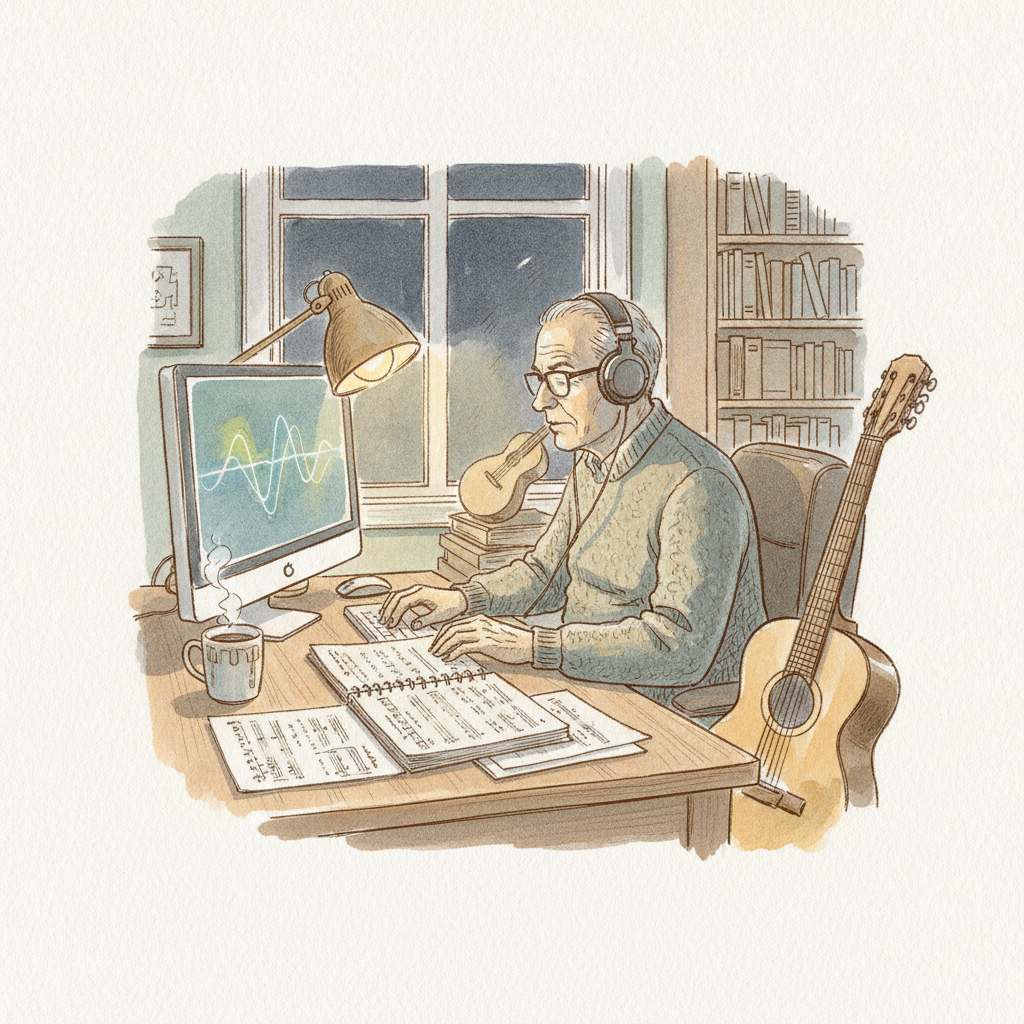
Song by song, the process is roughly this: I put together the demo, the song sheet, and the style. I run Wrecking Crew takes — twenty, forty, however many it takes. I pick the Bed. I decide Capitol or Kirshner. If Capitol, I fire cover passes, judge them, sometimes run the top two head-to-head. Then I crown a Master, and the song is done. The whole thing happens at my desk, between other things, whenever I have an hour. No booking, no scheduling, no session fees, no one else's availability to accommodate.
What changed — and what didn't
The real Wrecking Crew didn't get credit. No royalties, no names on the records — union scale was the entirety of their compensation, while the stars who sang over their beds became household names. I think about that. I'm using AI — a different kind of anonymous infrastructure — to build the beds my voice sings over, and the AI doesn't get credited either. Somewhere in that parallel there's something worth sitting with.
But here's the part that matters most to me, and I want it said plainly: nobody lost money on this record. There was never a session I was going to book. I couldn't have paid a drummer, a bass player, and an engineer in 1975, and I couldn't have paid them last year either — that's the whole reason these songs sat in notebooks for fifty years. No musician lost a dime on Milestones, because the alternative was never hiring anybody. The alternative was silence.
And I'm not going to make money on it either. There are no royalties coming that I could pass along to anyone. What I got instead was this: my songs lifted to a level I never expected to hear them reach. Strangers on a website had told me back in 2006 that the writing was good. What I'd never once had was the other thing — sitting in my own office and hearing one of them come back arranged and finished, sounding like the record I'd been carrying around in my head since I wrote it. That was the question that was actually still open after fifty years, and it's the one that finally got answered. Yes. Those songs were good, and now I can hear it.
What didn't change is the fundamental thing: someone has to decide what the song needs. Someone has to bring the demo, write the song sheet and style, pick the Bed, judge the takes, crown the Master. The Wrecking Crew was invisible, but the producers who directed them were making thousands of decisions. I'm making those decisions now, for my own songs, with tools those producers couldn't have imagined.
The function is permanent. The technology changes. The judgment — what does this song need, is this the take, is this done — that's still mine.
Milestones is mine. The Wrecking Crew built it. Capitol put my voice on it. Kirshner took one track straight through because that voice was already right. The vocabulary is borrowed from sixty years ago. The songs are new.